One of our Driscoll Cleaning customers recently mentioned that she was concerned about grease buildup in her kitchen. It is a problem that can sneak up on you.
You may wipe down the stove and countertops regularly and think everything is clean. Then one day you run your hand across a cabinet door and wonder why it feels sticky.
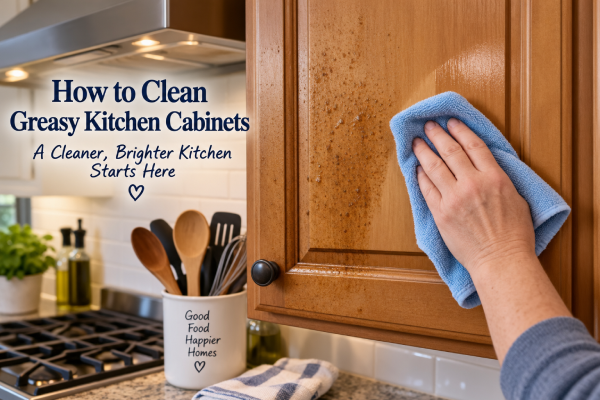
Cooking grease doesn’t necessarily stay around the stove. Tiny droplets can become airborne while you cook and eventually settle on cabinets, appliances, backsplashes and other surfaces. Add a little dust to that grease and, over time, you can end up with a sticky film that isn’t nearly as easy to wipe away as an ordinary layer of dust.
If you’re wondering how to clean greasy kitchen cabinets, the first thing to remember is that stronger isn’t always better.
Start With the Gentlest Cleaner
Before reaching for a heavy-duty degreaser, start simple.
For many washable cabinet surfaces, warm water with a small amount of mild dish soap is a good place to begin. Dish soap is made to cut through grease, and sometimes that’s all you need.
Use a soft cloth rather than something abrasive. You don’t want to solve the grease problem by creating a new problem with scratches or a damaged finish.
Don’t soak the cabinets, either. Your cloth should be damp rather than dripping wet.
Work on a small area at a time and then wipe away the soap and loosened grease with a clean damp cloth. Dry the surface afterward instead of leaving it wet.
Know What Your Cabinets Are Made Of
This is important.
Not all kitchen cabinets can be cleaned the same way.
Painted cabinets, laminate, finished wood and other cabinet surfaces may react differently to cleaning products. Something that works beautifully on one surface could dull, discolor or damage another.
If you aren’t sure what kind of finish you have, be cautious.
Before trying a new cleaner, test it somewhere inconspicuous. The inside of a cabinet door can be a good place. Give it a little time and make sure there is no change in the finish before using it everywhere.
Pay Attention Around the Handles
Take a close look at the area around your cabinet handles and knobs.
Those areas can collect quite a bit of grime because we touch them so often, sometimes while we’re cooking. Grease from the air combines with whatever is transferred from our hands.
The little edges and grooves around handles can also be easy to miss during regular cleaning.
A soft cloth can handle most of the job. For small crevices, a soft toothbrush can sometimes help, provided it won’t scratch the surface.
Don’t Forget the Tops of the Cabinets
If your kitchen cabinets don’t go all the way to the ceiling, take a look on top.
You might be surprised.
Grease that becomes airborne can eventually settle up there, and because the tops of cabinets aren’t something most of us see every day, that layer can sit undisturbed for a long time.
Then dust settles on top of it.
That’s when you can end up with a thick, sticky mess that takes considerably more work to remove.
The range hood and the cabinets closest to the stove deserve special attention for the same reason.
The Range Hood Is Part of the Job
Your range hood is designed to help capture grease, smoke and other cooking byproducts, so naturally it can get greasy.
The outside needs regular cleaning, but don’t forget about the filter.
Some range hood filters can be removed and washed, while others need to be replaced. Check the manufacturer’s instructions for your particular range hood before cleaning the filter.
A range hood can’t do its job as effectively if it is loaded with grease.
What About Really Heavy Grease Buildup?
This is where patience comes in.
If grease has been accumulating for months or even years, one quick wipe probably isn’t going to remove it.
You may need to clean the same area more than once.
I would rather make several gentle passes than immediately attack a cabinet with the strongest cleaner I could find. Once a cabinet finish has been damaged, cleaning it isn’t going to put the finish back.
For stubborn buildup, check the cabinet manufacturer’s cleaning recommendations before moving to a stronger product.
Be Careful With Homemade Cleaning Remedies
There are all kinds of homemade cleaning recipes on the Internet.
Vinegar and baking soda seem to show up in just about every list.
That doesn’t mean they’re appropriate for every surface in your kitchen.
Vinegar is acidic, baking soda is abrasive, and cabinet finishes vary considerably. Before using either one—or any homemade mixture—make sure it is safe for the particular surface you’re cleaning.
Natural doesn’t automatically mean harmless to a finish.
Keeping Kitchen Grease From Building Up Again
Once you have gone through all the work of removing old grease, keeping up with it is much easier.
Wipe the cabinets around the stove regularly instead of waiting until they feel sticky. Clean splatters when you notice them. Keep the range hood and filter maintained, and don’t forget those areas around the knobs and handles.
You don’t necessarily need to scrub the entire kitchen every week.
The idea is simply to remove the grease while it is still a light film instead of waiting until it has had months to collect dust and harden. Dust is another cleaning problem that likes to collect in places we don’t always notice.
A few minutes of regular cleaning can save you a much bigger job later.
Sometimes Kitchen Grease Just Gets Ahead of You
Kitchen grease is one of those cleaning problems that tends to build gradually. You don’t wake up one morning to discover that your cabinets suddenly became greasy overnight.
It happens a little at a time.
And because we see our own kitchens every day, sometimes we don’t notice the buildup until it has become a pretty good cleaning job.
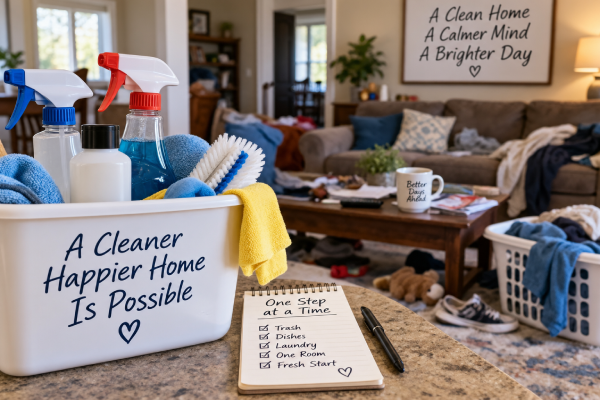
If that has happened in your kitchen, don’t feel like you have to tackle every cabinet, appliance and surface at once. Start near the stove, work on one section at a time and keep going. The same one-step-at-a-time approach works when the whole house has gotten away from you.
And if the job has become more than you want to tackle yourself, that’s one of the things we’re here for.
At Driscoll Cleaning, we’ve learned that sometimes a good cleaning isn’t about making a home look perfect.
It’s about helping someone get caught up—and making it a whole lot easier to keep it that way.