
October 9, 2026
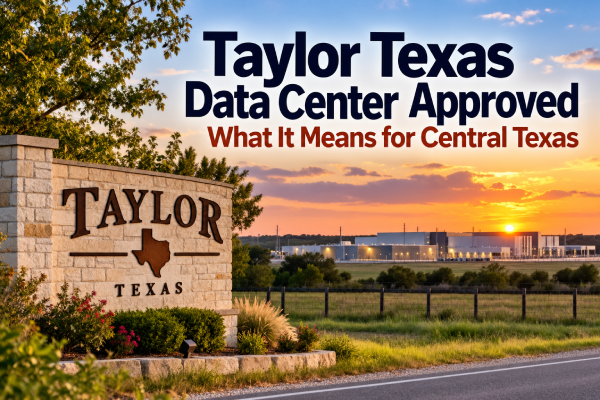
A major Taylor Texas data center development has taken an important step forward. On October 8, the Taylor City Council voted unanimously to approve an agreement involving a proposed 664-acre technology campus east of the city.
The development, known as Taylor Technology Campus, would include large data center facilities and an on-site power plant.
The decision came despite objections from residents concerned about water use, noise, air quality and the future of their community.
City officials say the agreement will provide greater oversight of the project. However, some residents believe more public discussion is needed.
What Is the Taylor Technology Campus?
The proposed development covers 664 acres between US Highway 79 and FM 112, just east of Taylor.
The project is being developed by Big Watt Digital and PowerHouse Data Centers.
Data centers house the computer servers that support internet services, cloud computing and artificial intelligence.
These facilities require substantial electricity. They may also need water for cooling, depending on their design.
The Taylor project includes plans to generate electricity on-site.
Developers say the campus will bring economic opportunities and additional tax revenue to the community.
Why Did Taylor Approve the Agreement?
The property is currently outside Taylor’s city limits in an unincorporated area of Williamson County.
Texas counties have limited authority to regulate development.
City officials say the agreement will allow Taylor to annex the property and establish rules that would otherwise be difficult to enforce.
These rules address water consumption, noise, lighting, drainage and setbacks from neighboring properties.
The council approved the agreement unanimously on October 8.
However, approval of the agreement does not mean every permit or construction requirement has been completed.
The development must still meet applicable regulatory requirements.
Water Use Is a Major Concern
Water is one of the biggest concerns surrounding large data centers in Central Texas.
Our region knows how important water conservation can be, especially during extended dry periods.
The Taylor agreement requires a closed-loop cooling system that uses reclaimed water.
Reclaimed water is treated wastewater that can be reused for certain purposes instead of drawing from drinking-water supplies.
According to the City of Taylor, the cooling system will have an initial fill volume of approximately 1.575 million gallons.
The agreement generally prohibits using drinking water for cooling, although certain exceptions are allowed.
Developers must also help fund wastewater infrastructure improvements.
City officials say these measures will help protect local drinking-water resources.
The actual long-term effects will depend on how the facility is built and operated.
What About Noise and Air Quality?
Large data centers can produce noise from cooling equipment, generators and power-generation systems.
This can be particularly noticeable in rural areas where residents are accustomed to quieter surroundings.
The Taylor agreement includes noise restrictions.
Noise from the development cannot exceed the greater of 65 decibels or the existing background noise level, as measured under the agreement.
An acoustic study will establish conditions before development begins.
The project must also meet Taylor’s lighting requirements.
Air emissions will remain subject to regulation by the Texas Commission on Environmental Quality.
These protections are intended to reduce the effects on surrounding properties.
However, some residents remain concerned about how the regulations will be enforced.
Protections for Nearby Homeowners
The agreement includes setbacks and landscaping requirements.
Buildings must generally be at least 300 feet from the north, east and west property lines.
Along the southern boundary, data centers and power-generation facilities must be set back at least 700 feet.
Additional landscaping and screening are required near FM 112.
The development must also meet stormwater management requirements.
These provisions are designed to reduce the effects of the project on neighboring properties.
For rural homeowners, concerns about drainage, lighting, noise and nearby industrial activity are understandable.
A large development can change the character of an area even when regulations are in place.
What Will Taylor Receive in Return?
The developers have committed an estimated $28.2 million toward community improvements and nonprofit support.
According to the City of Taylor, the commitments include:
- $13 million for city quality-of-life improvements.
- $10.2 million for Taylor ISD educational programs.
- $1.5 million for student scholarships.
- $1 million for career and technical education and workforce development.
- $1 million for animal care programs.
- Additional support for local nonprofit organizations.
City officials also project substantial property tax revenue over the coming decades.
However, these are projected benefits. The actual economic results will depend on the project’s completion and future operations.
Why Are Some Residents Opposed?
An overflow crowd attended the October 8 City Council meeting.
Many residents spoke against the agreement.
Their concerns included the speed of the approval process, environmental impacts and the potential for further industrial development.
Some residents wanted the city to delay its decision.
They argued that additional public meetings and stronger protections were needed before moving forward.
Earlier, Taylor’s Planning and Zoning Commission had delayed consideration of the project to allow more time for study.
The developers later withdrew their original annexation and zoning application.
City officials continued negotiating a separate agreement, which the council approved October 8.
Supporters believe the agreement provides protections that would otherwise be unavailable.
Opponents question whether those protections are sufficient.
Why This Matters Beyond Taylor
Taylor is not the only Central Texas community experiencing rapid growth in large technology facilities.
Rockdale and other nearby communities have also seen interest in data center development.
These projects can bring investment, construction activity and new tax revenue.
They can also raise important questions about electricity, water supplies, environmental effects and neighboring properties.
For those of us living in rural Central Texas, these are not distant concerns.
Decisions made today can affect the communities we live in for decades.
The Taylor agreement may also become an example for other cities considering similar projects.
What Happens Next?
The October 8 vote allows the development agreement to move forward.
The project will still face additional steps before construction and operation can proceed.
Residents will want to watch how the agreement’s protections are implemented.
Water use, noise levels, air quality and infrastructure improvements will be important issues as the project develops.
The economic promises will also deserve attention.
Central Texas Growth Comes With Important Decisions
Central Texas is changing.
Large technology developments are becoming part of the landscape, including areas that have traditionally been rural.
Growth can bring opportunities. It can also bring challenges.
The important question is whether communities can benefit from new development while protecting the things that make them good places to live.
Taylor has made an important decision about its future.
Now residents will be watching to see how that decision works in practice.
Driscoll Home Services will continue following major developments affecting homeowners and communities throughout Milam County and the surrounding Central Texas area.
Leave a Reply