
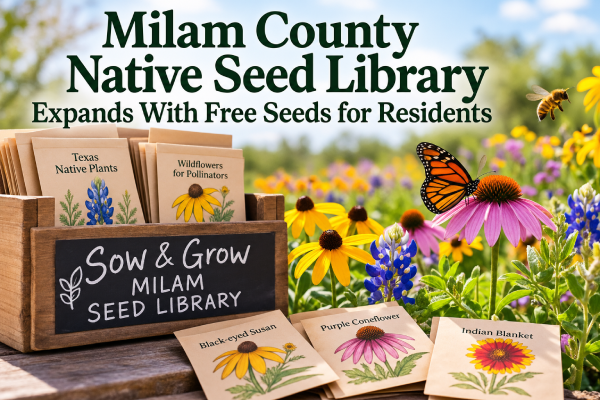
The Milam County Native Seed Library is expanding, giving Central Texas residents more opportunities to grow native plants and support local wildlife. Thanks to new funding from H-E-B through the Pollinators for Texas initiative, the El Camino Real Chapter of the Texas Master Naturalists plans to make free native seeds available at additional locations throughout Milam County.
The project, called Sow & Grow: Milam Seed Library, helps residents create natural habitats for bees, butterflies, and other important pollinators.
And the best part? The seeds are free!
Where Can You Get Free Native Seeds in Milam County?
The Sow & Grow program began in January 2025 at the Cameron Public Library. A second seed library was later established at the Milam Wildscape at Bird and Bee Farm.
Currently confirmed seed locations include:
- Cameron Public Library – 304 E. 3rd Street, Cameron, Texas.
- Milam Wildscape – Located at Bird and Bee Farm near Milano, Texas. Check access arrangements before visiting.
With the new funding, the chapter plans to add two more locations:
- Lucy Hill Patterson Memorial Library in Rockdale.
- The wildscape near All Saints Episcopal Church in Cameron.
The chapter announced plans to add the Rockdale location in September. However, current operating details for both new locations should be confirmed before visiting.
Seed quantities may be limited to ensure that more residents can participate.
Why Are Native Plants Important?
Native plants are naturally suited to the climate, soil, and wildlife of Central Texas.
Once established, many native plants require less supplemental watering than nonnative landscaping plants. They can also provide food and shelter for wildlife.
Their benefits include:
- Supporting native bees and butterflies.
- Providing nectar and pollen for pollinators.
- Creating habitat for beneficial insects and birds.
- Helping conserve water once plants become established.
- Adding natural beauty to yards and gardens.
Pollinators play an important role in our environment. Many plants depend on insects and other animals to help them reproduce.
Even a small patch of native flowers can make a difference.
You Don’t Need a Large Yard to Help
One of the nicest things about the Sow & Grow program is that almost anyone can participate.
You don’t need several acres of land or an elaborate flower garden.
Native plants can be added to flower beds, planted along fences, or grown in a sunny corner of the yard.
Rural property owners may have room for larger patches of native wildflowers and grasses.
Even homeowners with limited outdoor space can provide valuable habitat by choosing suitable native plants.
Fall Is a Good Time to Plant Many Native Wildflowers
Fall is an excellent planting season for many Texas native wildflowers.
In nature, wildflowers drop their seeds onto the ground after blooming. The seeds remain in the soil through winter, and some species benefit from exposure to cold temperatures.
This natural process is called cold stratification.
When spring arrives and temperatures rise, the seeds may begin to germinate.
Some native plants take longer to establish. Certain seeds may not emerge until a later growing season.
So don’t be discouraged if your wildflowers don’t appear immediately!
For the best results, follow the planting instructions for each species. Many native wildflower seeds need good contact with the soil, and some require light to germinate.
Learn More About Native Texas Plants
If you’re new to native gardening, there is an excellent free resource available online.
The Lady Bird Johnson Wildflower Center maintains a searchable database of native plants.
You can look up plants by name and learn about their growing conditions, sunlight requirements, water needs, and other characteristics.
Visit the Lady Bird Johnson Wildflower Center Native Plant Database.
This is a helpful resource when deciding which native plants might work best on your property.
Meet the El Camino Real Texas Master Naturalists
The El Camino Real Chapter of the Texas Master Naturalists serves Milam County through conservation, education, and volunteer projects.
Members are interested in much more than gardening.
Their activities involve learning about and protecting native plants, grasses, birds, butterflies, bats, insects, spiders, snakes, and other parts of our natural environment.
The chapter also participates in habitat restoration and community education.
Everyone Is Welcome at Chapter Meetings
The El Camino Real Chapter meets on the second Thursday of each month at All Saints Episcopal Church, 200 North Travis Avenue, Cameron, Texas.
A potluck meal begins at 5:30 p.m., followed by the meeting and educational presentation at 6 p.m.
Visitors are welcome to attend.
The chapter is also preparing a new Texas Master Naturalist training class beginning in January 2027.
Anyone interested in learning more about Central Texas wildlife and conservation can watch for announcements through the chapter’s website, blog, and local news.
Learn more through the El Camino Real Texas Master Naturalists or visit their Nature Along the El Camino Real blog.
A Small Packet of Seeds Can Make a Big Difference
The expansion of the Milam County Native Seed Library is good news for homeowners, gardeners, and anyone who enjoys the natural beauty of Central Texas.
A few native wildflowers might seem like a small contribution. But when neighbors throughout the county begin planting them, those small patches can create valuable habitat for pollinators.
Whether you have a small backyard in town or several acres in the country, you can be part of the effort.
And thanks to the Sow & Grow program, getting started doesn’t have to cost anything.
Sometimes helping the environment really is as simple as planting a seed.
For more information about the seed library expansion, read the official Texas Master Naturalist funding announcement. You can also learn about the Milam Wildscape conservation project at Bird and Bee Farm.
Leave a Reply